

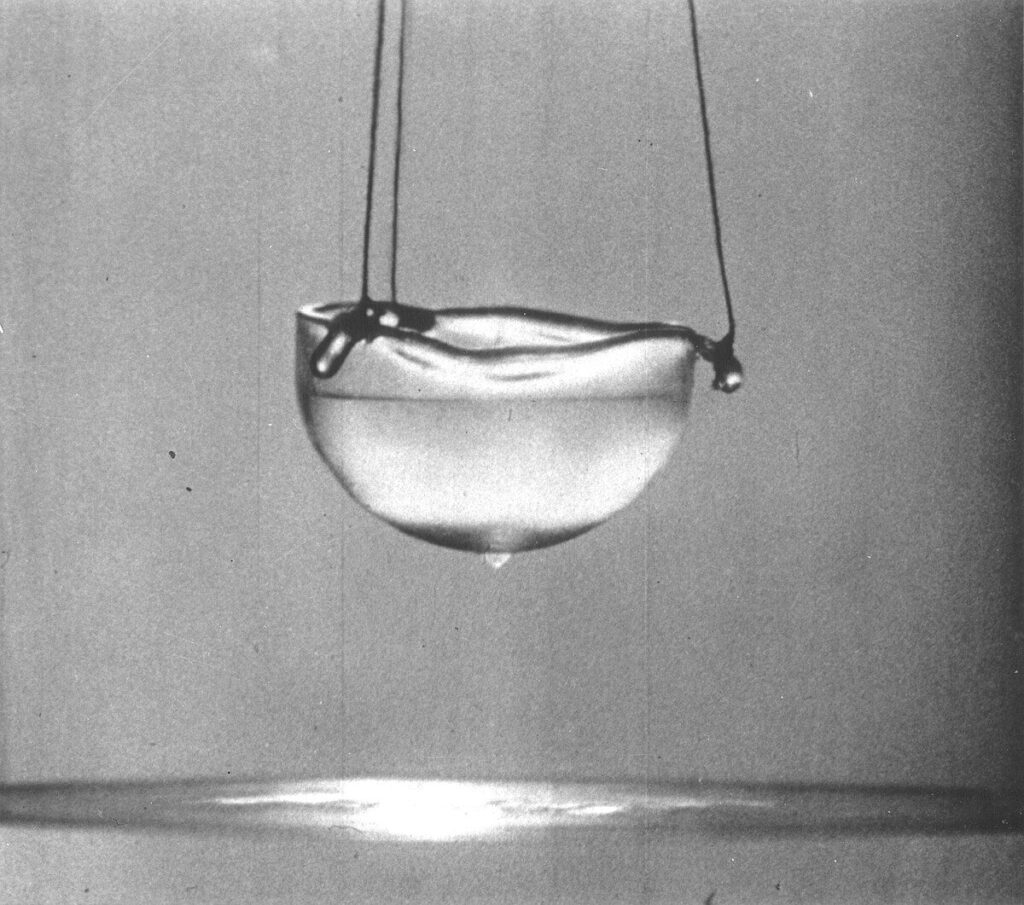
Liquid helium in superfluid phase. Photo: Alfred Leitner.
The world of condensed matter physics operates at extremes, where temperatures plummet near absolute zero and materials exhibit bizarre behaviors. Think of superconductors or superfluids – substances that defy ordinary physics. These transformations, known as phase transitions, are often explained by the Kibble-Zurek mechanism (KZM). However, KZM’s applicability to real-world scenarios, where the environment plays a significant role (open systems), has remained unclear until now.
Researchers Dr. Jayson Cosme and Roy Jara Jr. are from the University of the Philippines Diliman’s College of Science. They work at the National Institute of Physics (UPD-CS NIP). They have made a groundbreaking discovery. Their new research proves KZM’s validity in a broad class of open systems. It reveals critical subtleties in how we study phase transitions. Their work drew parallels between the controlled cooling of glass and the behavior of materials undergoing phase transitions. Think about annealing compared to rapid quenching for a crackled effect. This comparison offers a significant advancement in the field.
The team investigated how the cooling rate—or “quench speed”—affects the transition. They found that while KZM holds true for slow cooling, it breaks down at faster speeds. This was crucial. A standard laboratory method that relies on a threshold to detect phase transitions might be unreliable. It often falters with open systems experiencing rapid cooling. A time lag exists between reaching the threshold and the actual phase transition. This lag introduces errors in identifying the transition’s precise timing.
To overcome this limitation, they suggest alternative techniques that focus on parameters reaching a steady state during the phase transition. This study primarily focuses on large systems where quantum effects are negligible. The researchers aim to expand their work to include smaller systems where quantum effects become more pronounced. They also plan to study driven systems that might exhibit dynamic phases like time crystals. Their work leads to a better understanding of phase transitions. It allows for more accurate measurements. This paves the way for potentially revolutionary technological advancements.