

Filipino mathematicians have developed a new way to compare biological models. This method helps scientists identify potential drug targets.
Dr. Bryan Hernandez of the University of the Philippines Diliman led the project. He worked with Patrick Vincent Lubenia and Dr. Eduardo Mendoza of De La Salle University. Their team created the Common Species Embedded Networks (CSEN) analysis.
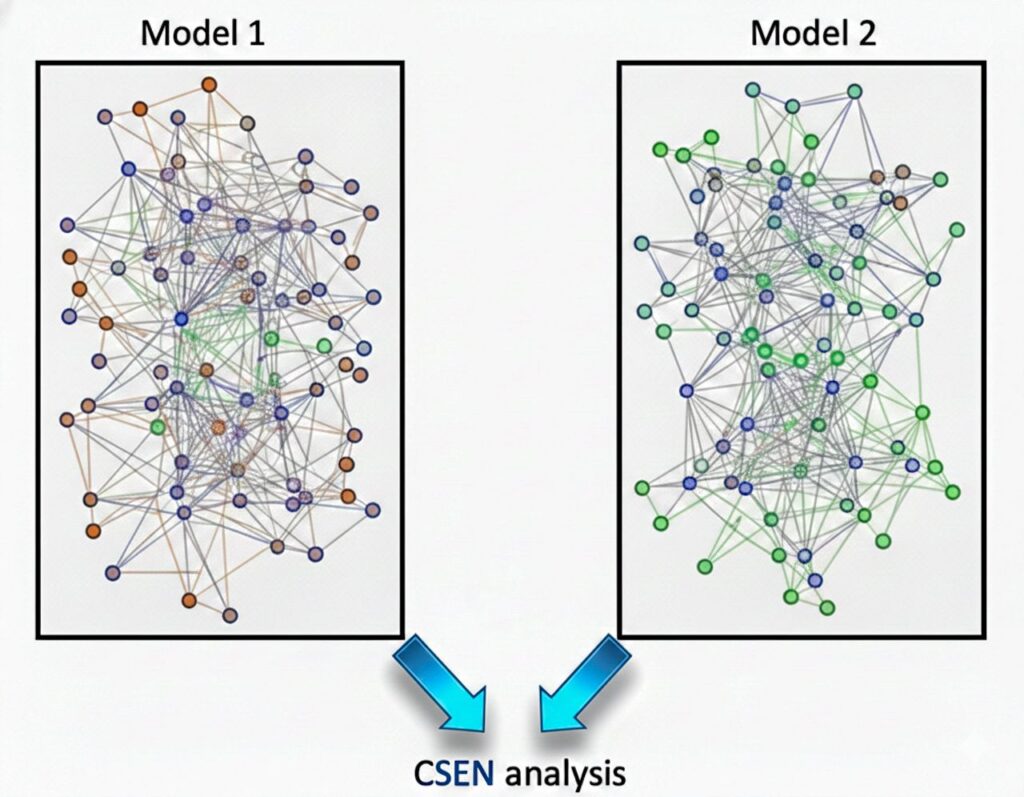
Biological pathways like Wnt signaling regulate cell development. Scientists represent these processes using reaction networks. Different research groups often propose different maps for the same biological system.
“In the field of systems biology, different researchers often propose different reaction networks to describe the same biological process,” Dr. Hernandez said. “Historically, it has also been difficult to compare these models because they are often treated as entirely separate entities, utilizing different sets of variables and reactions.”
CSEN allows researchers to compare these networks by focusing on common species like proteins or chemicals.
“The method works by first isolating the networks ‘embedded’ within the models that involve only the common species,” Dr. Hernandez explained. “For the reactions that are not identical, the method checks for ‘transformations’—mathematical links that can explain how one reaction set might induce equivalence between the systems with the underlying embedded networks.”
The team applied this to existing Wnt signaling models. They found that some models are structurally similar. This similarity suggests they share the same underlying biological dynamics.
“Traditional approaches often discriminate between models based on specific properties, such as whether they have one long-term state or the capacity for multiple long-term states,” Dr. Hernandez added. “CSEN is different because it looks at the underlying structure and dynamical equivalence.”
Researchers can use this tool to find redundant or unique parts of a model. If many models agree on a specific interaction, that interaction becomes a reliable drug target.
The method works for systems beyond Wnt signaling.
“While we demonstrated its use with Wnt signaling, it can be applied to any system represented by reaction networks,” Dr. Hernandez said. “This includes other biological pathways, such as insulin signaling or metabolism, as well as potentially non-biological networks such as chemical engineering processes or ecological models.”
The study, “Embedding-based comparison of reaction networks of Wnt signaling,” appears in the journal MATCH Communications in Mathematical and in Computer Chemistry.