

Agriculture in the Philippines continues to face challenges related to soil degradation, rising input costs, climate change, and declining farm productivity. In response, a growing number of farmers are adopting regenerative and circular economy principles that reduce waste while maximizing natural resources.
This photographer examines the experience of a farm-to-table agricultural enterprise that transitioned from conventional farming to a regenerative circular farming system.
Through soil restoration, composting, vermiculture, aquaculture, aquaponics, and nutrient recycling, the farm demonstrates how agricultural sustainability can be achieved through ecological design and resource efficiency.
When asked when their farming journey began, the farm owners offer two answers: 2010 and 2015.
The first date marks the beginning of what they now describe as doing agriculture “the wrong way.”
Like many farmers, they initially relied on conventional methods that required significant expenditures on inputs while yielding disappointing returns.
After five years of operation, the venture was suspended.
“We were spending more than we were producing,” Al Linsangan recalled. “There was no yield that justified the expenses.”
Rather than abandoning agriculture altogether, the couple spent a year traveling across the Philippines, studying successful farms and learning from practitioners of sustainable and regenerative agriculture in Batangas, Cavite, Tagaytay, Iloilo, Bacolod, Benguet, and Davao.
The lessons they gathered fundamentally changed their understanding of farming.
In 2016, they restarted—not by planting crops, but by rebuilding the soil.
Feeding the Soil Before Feeding the Plants
The cornerstone of regenerative agriculture is the recognition that healthy soil is a living ecosystem. That’s the secret, according to Al.
The farm’s soil had become compacted and biologically inactive after years of conventional practices.
Instead of immediately planting crops, the farmers focused on restoring microbial life.
Organic matter that was previously burned as waste was collected and composted. Through biocomposting, leaves, plant residues, and other biodegradable materials were transformed into nutrient-rich soil amendments.
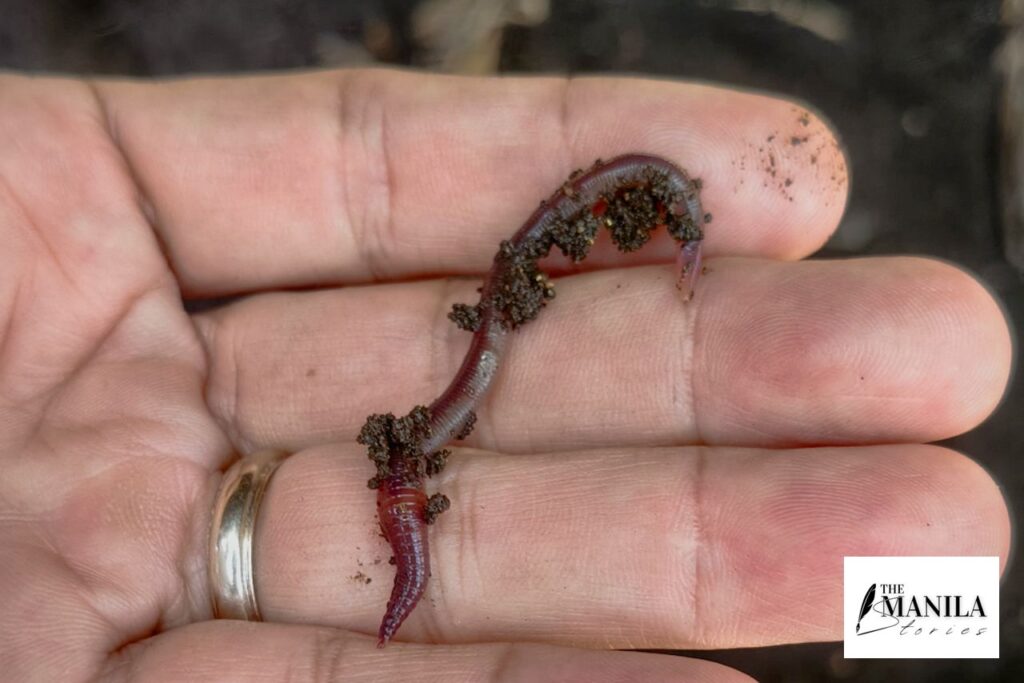
The appearance of earthworm mounds and soil organisms became indicators of success.
“The soil is alive,” Al explained.
The process mirrors what naturally occurs in forests, where fallen leaves, animal waste, and decomposing organic matter continuously create fertile topsoil.
The farm adopted the forest as its ecological blueprint.
Biocomposting and Vermiculture.
A key component of the farm’s circular economy model is biocomposting.
Organic residues are layered and allowed to decompose naturally over two to three months, eventually becoming fertile soil. To improve soil structure, compost is mixed with carbonized rice hull (CRH), an agricultural byproduct that increases aeration and prevents soil compaction.
The farm also maintains vermiculture beds populated by African Nightcrawler worms. These worms accelerate decomposition while producing nutrient-rich vermicast, widely recognized as one of the most effective organic fertilizers available.
The result is a continuous cycle where agricultural waste is converted into resources that improve soil health and plant productivity.
Aquaculture and Nutrient Cycling
The farm extends circular economy principles beyond soil management.
Its aquaculture system integrates ducks, fish, aquatic plants, and microorganisms in a mutually beneficial cycle.
According to caretaker Rizal Dio, fish ponds are strategically connected to duck enclosures.
Nutrients from duck manure stimulate algae growth and microbial activity in the water, creating a natural food source for fish.
The farm also cultivates Azolla, a floating aquatic fern known for its high protein content and nitrogen-fixing capabilities. Azolla serves as feed for ducks and fish while improving water quality.
Rather than treating animal waste as a disposal problem, the system views it as a valuable resource.
In this model, waste from one component becomes an input for another.
Aquaponics: Integrating Fish and Vegetables
The farm further closes the nutrient loop through aquaponics; fish raised in tanks produce nutrient-rich water that is circulated to vegetable-growing areas.
Plants absorb dissolved nutrients from fish waste, effectively filtering the water before it returns to the fish system.
The farm uses natural gravity and terrain slopes to aerate the water, reducing energy consumption while maintaining oxygen levels for fish.
Excess nutrient-rich water is directed to rice fields, ensuring that no valuable resource leaves the system unused.
This integration demonstrates one of the central principles of circular agriculture: maximizing resource efficiency while minimizing waste.
Farm-to-Table and Circular Economy
The farm’s practices align closely with the principles of the circular economy, an economic model designed to eliminate waste and continuously reuse resources.
Traditional agriculture often follows a linear pattern:
Input → Production → Waste
By contrast, the circular model follows:
Resource → Production → Reuse → Regeneration
Within the farm:
Organic waste becomes compost.
Compost feeds the soil.
Healthy soil produces crops.
Crop residues feed compost systems.
Animal waste nourishes fish and aquatic plants.
Fish waste feeds vegetables.
Water is recycled throughout the farm.
Each component contributes to the productivity of another.
This reduces dependency on synthetic fertilizers, lowers operational costs, and increases ecological resilience.
Challenges
Despite its benefits, regenerative circular farming presents significant challenges.
Knowledge and Training
The transition requires extensive learning and technical understanding. Farmers must understand soil biology, composting, aquaculture, water management, and ecosystem interactions.
Time Investment
Unlike synthetic fertilizers that produce rapid results, soil regeneration may take years before measurable improvements occur.
Labor Requirements
Managing multiple interconnected systems demands more observation and maintenance than conventional monoculture farming.
Market Acceptance
Consumers may appreciate sustainably produced food, but premium pricing remains difficult in markets dominated by cheaper conventional products.
Climate Vulnerability
Even regenerative farms remain vulnerable to typhoons, droughts, and extreme weather events, which are becoming more frequent due to climate change.
Can Circular Agriculture Be Sustainable?
The evidence suggests that circular agriculture offers one of the most promising pathways toward long-term sustainability.
Environmentally, it improves soil health, biodiversity, and water efficiency.
Economically, it reduces dependence on expensive external inputs by generating resources within the farm.
Socially, it supports local food systems and strengthens farm resilience.
However, sustainability depends on continuous education, proper management, and supportive policies that encourage regenerative farming practices.
The farm’s journey demonstrates that sustainability is not achieved through a single technology or method. Instead, it emerges from understanding ecological relationships and designing systems that mimic nature.
The story of this farm is ultimately a story of transformation.
Its first chapter ended in failure, characterized by depleted soils, rising costs, and disappointing harvests.
Its second chapter began with a simple but profound realization: healthy farming starts beneath the ground.
By feeding the soil before feeding the crops, integrating composting, vermiculture, aquaculture, and aquaponics, the farm has created a living example of agricultural circular economy principles in practice.
As the Philippines searches for solutions to food security, climate resilience, and sustainable rural development, farms such as this offer valuable lessons.
They demonstrate that agriculture can move beyond extraction and waste toward regeneration, where every output becomes an input and where nature itself becomes the model for long-term prosperity.