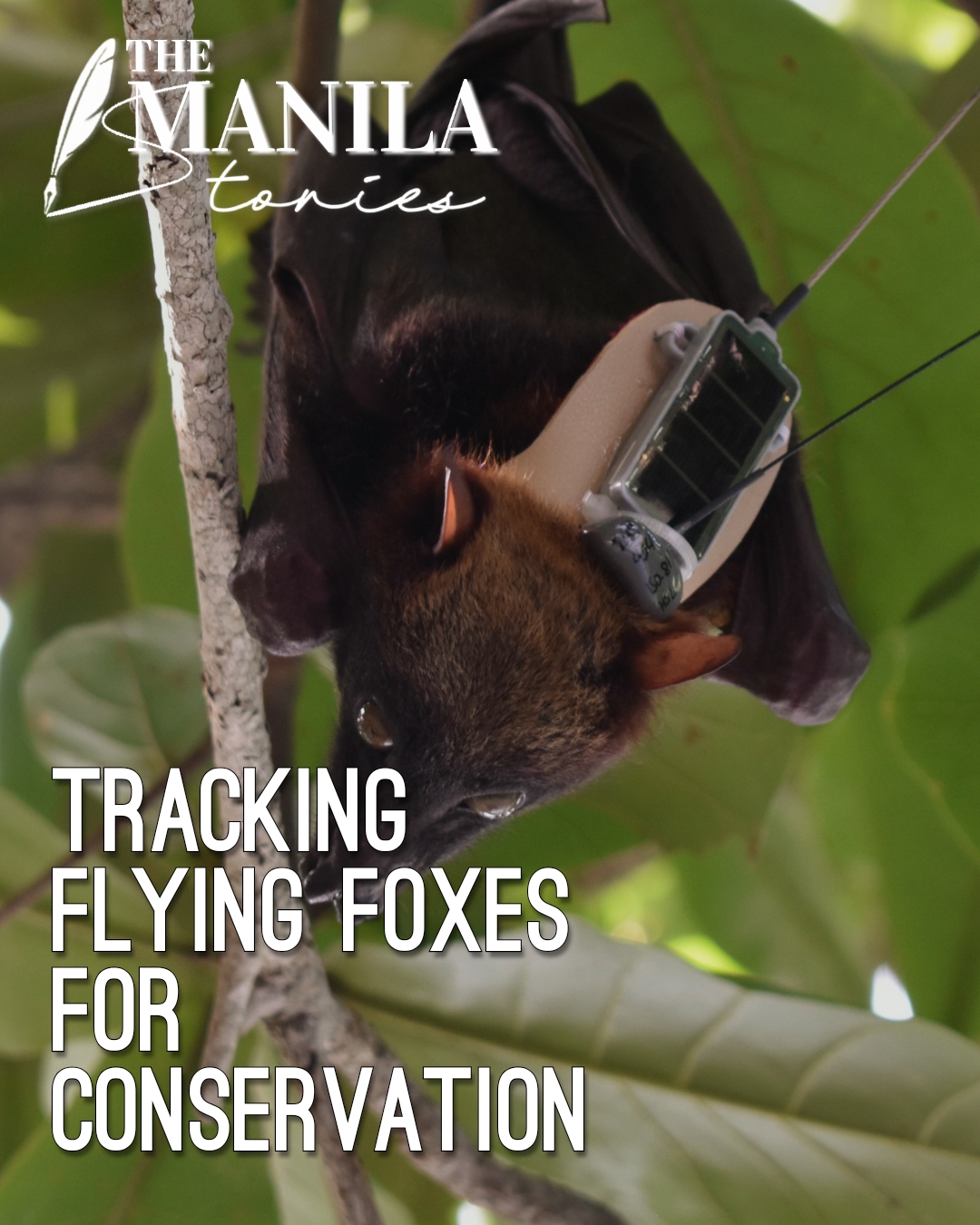
Researchers in the Philippines are tracking large fruit bats to protect their populations. A team from the University of the Philippines Diliman recently mapped the movements of flying foxes. The new data aims to support local conservation efforts.
Flying foxes are large bats that eat fruits and flowers. They travel long distances every night. Some bats fly more than 20 kilometers from their sleeping areas to forage. They easily cross islands and international borders. Over a single year, these animals can travel more than 6,000 kilometers. This makes them some of the most far-ranging bats in the world. They often move too fast and too far for humans to easily track them.
To solve this problem, biologists from the UP Diliman College of Science Institute of Biology teamed up with other experts. They captured nine flying foxes from three different species. The team fitted the bats with lightweight GPS collars.
The researchers included Rio Renato Constantino, Czarina Espiritu, Maria Sabrina Tabeta, Simeon Gabriel Bejar, and Dr. Mariano Roy Duya. They worked alongside experts from UP Los Baños, Duke-NUS Medical School in Singapore, the Uniformed Services University in the United States, and the Research Institute for Tropical Medicine.
The team studied three specific species. These are the golden-crowned flying fox, the large flying fox, and the small flying fox.
Data on these bats has historically been scarce. “There’s just not a lot of data about flying fox movements in the Philippines,” Constantino said. “There have only been two studies about it so far, and both for the same two species and in the same place, which forms a fraction of these species’ range. Meanwhile, no such studies have been done for the small flying fox at all, anywhere.”
Researchers collected data while the bats slept. They quietly approached the sleeping animals with handheld antennas. Then, they downloaded the GPS movement data directly from the collars.
The sample size was small. However, the initial findings show clear patterns. The golden-crowned and large flying foxes appear to travel farther than the small flying fox. The species also differ in how they return to roosts and visit feeding sites. All three use a wide range of habitats. They travel through both built-up areas and human-modified farmlands.
Constantino noted that studying these elusive bats is fascinating. “By learning where they go, we learn more about their habitat use and what kinds of places they like to frequent. Do they stay in forests? Do they visit cities often?” he said. “At sunset they fly out of the roost and disappear into the night. Where do they go? That’s what we wanted to answer.”
Tracking these movements helps scientists understand how bats use different environments. This information is vital for future conservation and management plans.
Flying foxes provide critical ecological services. “They serve a number of important ecological functions, among them seed dispersal,” Constantino explained. “After a flying fox eats fruit, it poops out the seed, often a considerable distance away from the tree where it obtained its meal. In this way, flying foxes help maintain fruiting tree populations and help forest regeneration.”
Protecting known roosts is a top priority. Experts advise minimizing human disturbance in these areas. “If you don’t disturb them, they won’t go away; and if you know where they are, you can avoid them,” Constantino said.
The new tracking data will improve land-use planning. It will also guide conservation strategies to protect both local biodiversity and public health.
The research team published their findings in the journal Mammalia. The paper is titled “Movement patterns of three species of flying foxes across human-modified landscapes in the Philippines.” Mammalia is an international, multidisciplinary journal that focuses on mammalian diversity.