

The Philippine property market faces major macroeconomic challenges while shaping local tourism trends. Real estate consultancy Leechiu Property Consultants (LPC) released its third-quarter reports for 2026. The findings show mixed growth across property, residential, capital, and tourism sectors. High inflation, high interest rates, and a weaker peso continue to weigh on the overall market. However, hotel developments and urban redevelopment efforts point to strategic opportunities.
Foreign Tourist Arrivals Stall Near 4.4 Million
Foreign visitor arrivals reached 4.4 million in the first eight months of 2026. This total stays flat compared to 4.38 million in 2025. Arrival growth peaked at 12% in February 2026. Momentum slowed in April. Arrivals turned negative year-on-year starting in May.
The ongoing Iran conflict doubled jet fuel prices after closing the Strait of Hormuz. Higher fuel costs increased airfares and caused flight cancellations. Long-haul travel to the Philippines became more expensive. Full-year tourist arrivals are now expected to fall below 2025 levels.
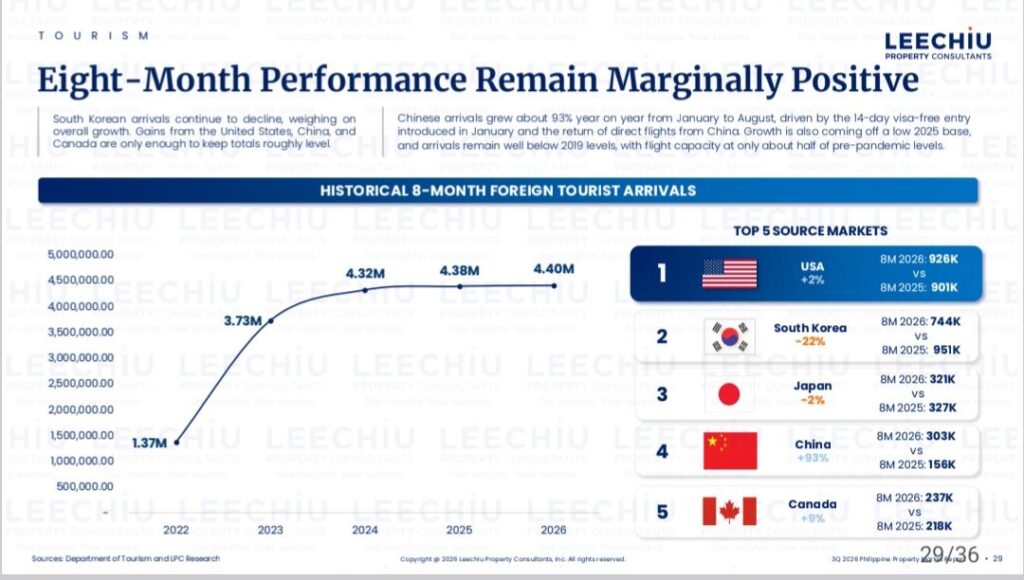
Source markets show contrasting movements. The United States remains the top source market with 926,000 visitors. South Korean arrivals dropped 22% to 744,000. Chinese tourist arrivals surged 93% to 303,000. This increase followed the introduction of 14-day visa-free entry in January. Direct flights from China also resumed. India saw growth above 50% in the first quarter.
Hotel Developers Focus Expansion Near Flight Hubs
Property developers continue to build hotel supply despite slower arrival growth. The 2026 Accommodation Pipeline Report counts 45,884 keys across 213 tracked projects. This represents a 14% increase in keys from 2024. Total committed investment capital reached PHP 387 billion.
Hotel supply follows direct international flight access. About 70% of planned keys sit in areas with direct international flights. Metro Manila leads with 11,130 keys. Cebu and Lapu-Lapu follow with 8,482 keys. Clark holds 3,727 keys. Panglao Island has 3,299 keys. Davao accounts for 755 keys.
LPC identified Eastern Luzon as a growing area for domestic tourism. Nearby provinces sit within one to four hours of Metro Manila. Rizal, Bulacan, Nueva Ecija, and Quezon currently have no pipeline keys. Major infrastructure projects will improve travel times to these regions. Key projects include SLEx Toll Road 4, CLLEx, MRT-7, and MRT-4.
Adam Domingo, Senior Manager of Hotels, Tourism, and Leisure, emphasized the role of travel efficiency:
“Unless we change how we do tourism at a basic level, foreign arrivals are likely to stay near today’s levels into next year.”
“The clearest evidence for what works comes from China and India. Where the Philippines made travel easier, through visa-free entry and additional direct flights, arrivals from both markets grew by more than 50% in the first quarter, and China has sustained that pace since February. Reducing travel friction produces results.”
“The same logic shows up in the hotel pipeline. About 70% of planned hotel rooms are in areas with direct international flights, which shows that private developers are building where access is strongest.”
“The report’s pipeline map also points to a gap. Some destinations with strong private-sector commitment, such as Puerto Princesa, are served by international airports that sit underused because they have no direct international routes. Developers are betting on these places, but travelers cannot yet fly to them directly. Government can match that commitment quickly by introducing direct international routes to these destinations. Compared with building or expanding airports, new routes can be put in place sooner and can lift arrivals faster.”
“On domestic tourism, which earns four times what foreign travelers bring in, we also need a closer look at the relocation of turboprop flights from NAIA to Clark. Island destinations that depend on turboprops report that business is down. Is the relocation a factor? The industry needs the data to answer that. A review of the impact would show what works best for the whole industry, from travelers and resorts to the workers who depend on them.”
Macroeconomic Factors Constrain Property Markets
Slower economic growth affects overall property activity. Gross domestic product growth slowed to 2.3% in the second quarter of 2026. Year-on-year inflation reached 7.2% in September. The Bangko Sentral ng Pilipinas raised its policy rate to 5%. The Philippine peso traded near historic lows at PHP 62.64 to the US dollar in October.
Higher financing costs continue to affect buyer demand. Construction costs remain high due to imported material prices. Income growth lags behind property prices. These factors create an affordability barrier across property segments.
Miggy Galvez, Analyst of Investment Sales, commented on capital market conditions:
“The current slowdown in real estate isn’t a lack of appetite it’s jammed execution. High construction costs, elevated interest rates, and stretched purchasing power have temporarily locked the market. The demand hasn’t vanished; it’s simply waiting.”
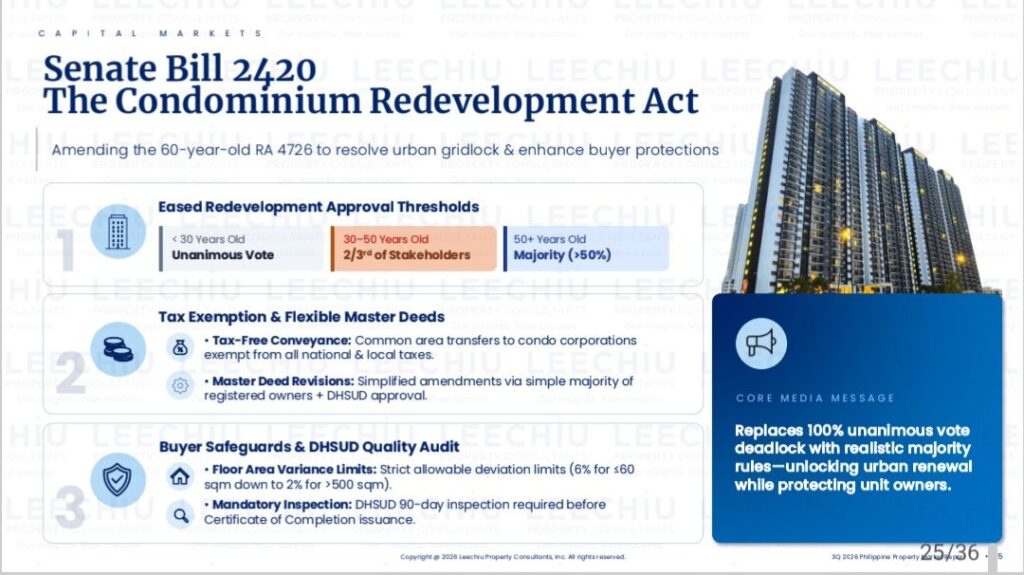
“The Condominium Redevelopment Act could fundamentally change urban renewal. By lowering the voting threshold for older buildings, we can unlock prime land stuck in aging structures, turning underutilized assets into high-value redevelopment opportunities.”
“Rough market conditions don’t eliminate opportunity; they reshape it. Between emerging income streams and policy reforms unlocking older urban supply, those who position themselves now will capture the next growth cycle.”
Legislative Reform and Residential Market Performance
Senate Bill 2420 proposes the Condominium Redevelopment Act. The bill aims to lower approval thresholds for aging structures. Buildings over 50 years old would require majority owner approval for redevelopment. Buildings aged 30 to 50 years would require a two-thirds vote. About 28% of buildings in the Makati Central Business District are over 30 years old. This reform could unlock prime urban land for new commercial or hospitality projects.
The Metro Manila residential market recorded 8,454 units sold in the third quarter of 2026. This reflects a 17% increase from the prior quarter. Developer promotions and government financing programs supported sales. Unsold inventory declined to 80,000 units. Months of supply dropped from 34 to 28 quarters.
Sharon Joy Roset-Saclolo, Associate Director and Head of Research, noted:
“Developers and government programs are helping bridge affordability and financing gaps that have historically prevented some buyers from entering the market. While these efforts are supporting transactions and helping move inventory, we expect buyers to remain selective and focused on value, quality, financing flexibility, and capital preservation. The challenge for the market is whether current demand levels can be sustained as economic and geopolitical uncertainties continue to influence purchasing decisions.”
Office Demand Rebounds in Third Quarter
Gross office demand reached 276,000 square meters in the third quarter of 2026. This represents a 33% increase from the second quarter. Year-to-date gross demand reached 754,000 square meters. IT-BPM firms and traditional occupiers led market activity. Metro Manila accounted for 81% of office take-up. Makati City led all districts with 141,000 square meters leased.
Marco De Padua, Senior Manager of Commercial Leasing, stated:
“While the headwinds this year are real and persistent, occupiers have largely adapted to the situation and continued to take space. We see that in third quarter demand reaching 276,000 sqm. We also see this year that the market is inclined towards PEZA-registered buildings. We look forward to seeing how the lifting of the ecozone moratorium under AO No. 45 opens that market to new buildings.”