
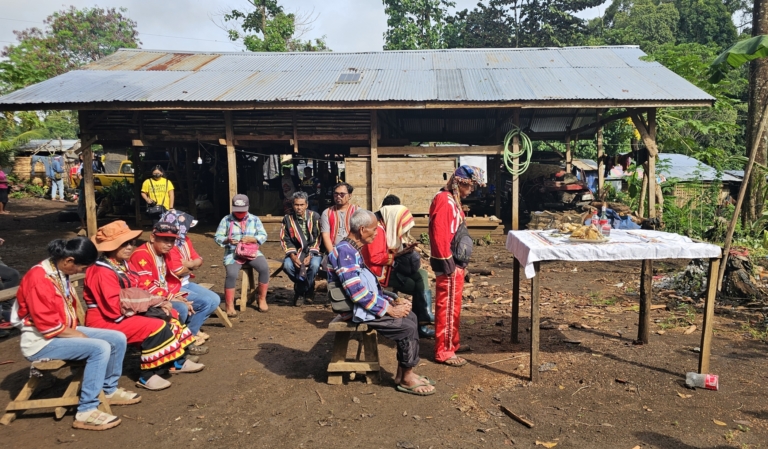
Amnesty International Philippines issued a strong call to the government on October 30, 2026. The organization demanded the safe and permanent return of the Manobo-Pulangiyon Kiantig Indigenous Cultural Community to their ancestral land in Quezon, Bukidnon.
This demand marks the end of National Indigenous Peoples Month. The community observed the month with a ritual of solidarity. They stood with other indigenous groups whose lands were seized by corporations with government acquiescence.
Bae Luisa Oreño spoke during a press conference in Manila. She serves as a leader of the community.
“Our people, the Manobo-Pulangiyon Kiantig was granted the Certificate of Ancestral Domain No. 261 in January 2023, officially recognizing our ownership of more than 1,100 hectares of ancestral land. Nearly four years later, we have yet to take effective possession of a land that’s already ours to begin with,” Bae Luisa said.
Amnesty International Philippines stressed that the title remains mere ink on paper. The community must be allowed back to step into and settle on their land. The call for a safe and permanent return defines this urgent mission.
Ritz Lee Santos III serves as the Section Director of Amnesty International Philippines. He explained the scope of the demand.
“Amnesty International Philippines’ call for safe and permanent return means freedom from harassment and threats of arrest, an end to duress by way of aid blockades exacerbating their already precarious situation, as well as red tape, and bureaucracy. An end to decades-long displacement means returning to their ancestral domain with real security of re-possession without any risk of being pushed out again. Safe and permanent means a return that no one can reverse,” Mr. Santos stated.
On October 22, 2026, the National Commission on Indigenous Peoples endorsed about 600 hectares to the Land Registration Authority for the Certificate of Non-Overlap. The community welcomed this step. However, the action is only partial. It arrived three years after the title was issued.
Bae Cheryl Caro is another leader of the community. She lamented the ongoing struggle.
“After our CADT was granted, it had been found to overlap with other claims and contained inconsistencies in its technical description. We have met every requirement asked from us by the NCIP and have followed up repeatedly with them and the LRA. But our situation never changes, our displacement continues. The NCIP did not issue an order enabling our community’s return citing disputes over boundaries. Our community leaders have done everything, even traveling to Manila to follow up every office, each time a new requirement, and we remain living and waiting by the side of the road when we return home,” Bae Cheryl said.
Community members report ongoing harassment. Intimidation and threats come from private guards of the Kiantig Development Corporation. The corporation occupies the area.
Families live in shanties along the highway near the Pulangi river. They stay close to their ancestral land. More than a hundred people remain there. Many others scattered across different provinces to earn a living.
“The land we were displaced to is not suitable for farming, and we have inconsistent access to food and clean water, which has made community members, especially children, sick. The NCIP said they will talk to adjacent ancestral domain about the temporary settlement within the area, while our case against KDC continues because of the petition for certiorari. We accepted the offer because we are left with no other choice, but our conditions were clear – that this arrangement is temporary and the move must be approved by the community, and can only voluntary. We demand a clear timeline which points to preserving our right to return to our ancestral domain,” Bae Cheryl reiterated.
The Indigenous Peoples Rights Act prevents relocation without Free, Prior, and Informed Consent. The United Nations Declaration on the Rights of Indigenous Peoples provides the same protections. It includes the option of return where possible.
For the community, land is tied to identity and survival. Their ancestors lived on that exact land.
“Being kept away from our home also separates us from our sacred sites, our ancestors’ resting places, our food and medicines. The falls and the forest where we gather our food and medicines are not just places to us, they are who we are. All our attempts to return to our ancestral land were met with closed gates and guns,” Bae Luisa shared.
The law recognizes native titles. It protects indigenous rights to stay within territories. It guarantees the right to return after displacement.
“IPRA already informs what should happen to MPK’s case, what’s lacking is the proper implementation of the law. The slow and tedious process that MPK endured from government agencies is a form of human rights violation. IPs continue to pay for the inaction of the Philippine government. Amnesty has written to the respective committee chairs in both houses for cultural communities and indigenous peoples, we only received an acknowledgement receipt, nothing substantive yet. IPRA also provides for legislative oversight to ensure that ancestral domain processes are timely, transparent, and effective for all indigenous communities. Amnesty is open to working with legislators, we are highly urging them to act now and not let MPK be kept out of their ancestral domain,” Mr. Santos added.
The campaign urges President Ferdinand Marcos Jr. to act. He must order the NCIP to identify remaining technical requirements. The agencies must set clear timelines.
The Department of Environment and Natural Resources and the Land Registration Authority must implement the title. They must support the community’s return plan with adequate resources.
“We are also calling for NCIP and LRA to first and foremost complete the amended map and CNO without further delay. The MPK ICC has waited long enough! Wakasan ang pangamba! Safe and permanent return for the Manobo-Pulangiyon Kiantig now!” Mr. Santos concluded.