

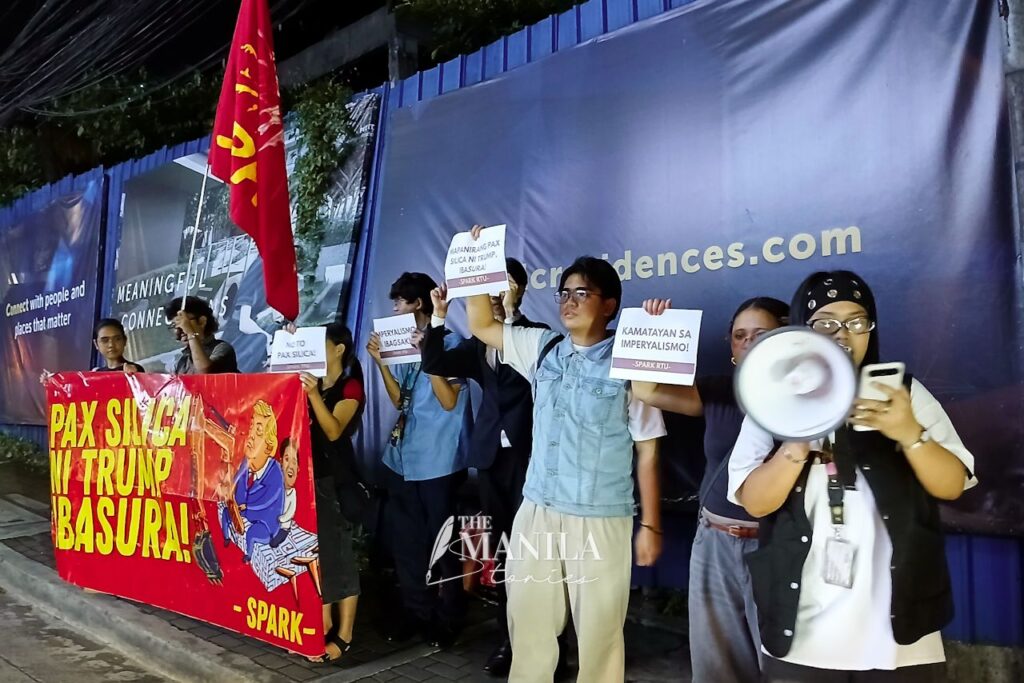
Academics at the University of the Philippines Diliman questioned the social, environmental and economic impacts of the Pax Silica initiative during a public forum on Oct. 19, 2026.
The UP Diliman College of Science hosted the event through its Science and Society Program. The forum marked the college’s 43rd anniversary. Scholars examined how the technology and mineral initiative affects ordinary Filipinos.
“For the Philippines, participation in this initiative raises important questions,” said Leilani Dacones, associate dean of the UP Diliman College of Science. “What opportunities might it bring to our science and technology sectors? How might it affect our industries, research institutions, and workforce? And perhaps most importantly, who stands to benefit from these developments, and what challenges or trade-offs should we consider?”
Mining and the Resource Curse
Dr. Cielo Magno, a professor at the UP School of Economics, analyzed the global race for critical minerals. She noted that public debate shifted from data centers in Clark, Pampanga, to mining and mineral processing.
The Philippines and Indonesia produce over 70% of the world’s nickel. Most of this raw nickel goes to China for processing.
“Of the 20 critical minerals needed for the energy transition, China also controls the processing of 19,” Magno said. “Against this backdrop, we can better understand the United States’ interest in the Philippines.”
Magno cited an unpublished memorandum of understanding between the United States and the Philippines. She learned about the deal from sources at the Department of Environment and Natural Resources. The agreement reportedly grants the United States first access to Philippine mining areas.
“I have been discussing mining for over a decade, and the conversation about downstream processing has gained momentum,” Magno said. “How do we maximize this opportunity, and how will we, as a country, benefit?”
Magno warned against the “resource curse,” where mineral-rich nations fail to develop economically. She urged the government to ensure fair pay, environmental accountability and long-term benefits.
“The Philippine government must also have a comprehensive sustainable development plan for mining communities,” Magno said. “Mining is highly mechanized and technical, so it does not necessarily create a significant number of jobs. Mining revenues should therefore be used to support other industries independent of mining, ensuring that communities have alternative sources of livelihood when mining operations end.”
Water Supply and Biodiversity Risks
Dr. Jelaine Gan of the UP Diliman Institute of Biology examined the environmental footprint of the project. She noted that the initiative relies on Philippine minerals, low-cost labor and strategic location.
“The proposed site for Pax Silica covers approximately 3.3 times the area of UP Diliman,” Gan said. “Allocating land for one purpose means displacing other uses. This land is used for agriculture by Indigenous communities.”
Gan showed aerial images of the site, which contains farms, forest patches and built-up zones. She warned that destroying these habitats threatens unique species in the megadiverse nation.
A nearby river system borders the proposed site. Gan compared the facility’s resource consumption and waste output to a human brain.
“I think of Pax Silica as a brain—a processing center,” Gan said. “Like the brain, it needs resources to function, including water supplied by this river system. When the brain is damaged, it can experience imbalances and release toxins that circulate throughout the body and affect other areas. Similarly, the river system may serve not only as a source of water for the facility but also as a potential pathway for its waste.”
Data from the Bases Conversion and Development Authority shows the site requires 65 million to 90 million liters of water daily. Gan noted this equals 26 to 36 Olympic-sized swimming pools every day. At peak demand, the facility would use over 13,000 pools per year.
This water volume matches the residential demand of Angeles City or Baguio City. Proponents plan to draw surface water from the Bangot, O’Donnell and Abacan rivers. Gan said this could require new dams or reservoirs.
She also questioned the viability of desalination for inland Tarlac. Pumping seawater inland and disposing of salty brine presents major logistical hurdles.
“So it doesn’t make sense, at least for me,” Gan said.
Geopolitical Pressure
Political science professor Herman Joseph Kraft compared Philippine foreign policy to the Greek epic “The Odyssey.” He likened the nation’s dilemma to sailing between the sea monsters Scylla and Charybdis.
“Is there no way of avoiding Charybdis while keeping Scylla at bay?” Kraft asked.
Kraft said the Philippines must reduce its vulnerabilities amid intense rivalry between the United States and China. While Manila favors Washington, Beijing is expanding its regional influence. China recently launched the rival World Artificial Intelligence Cooperation Organization.
Caught between territorial disputes in the West Philippine Sea and its U.S. alliance, Manila faces pressure to pick a side. Kraft urged leaders to protect national interests without limiting their diplomatic options.
True Industrialization
Dr. Giovanni Tapang of the National Institute of Physics questioned who truly profits from extracting copper and nickel. Under the deal, the Philippines supplies land, labor, power and water while absorbing environmental damage.
“Industrialization is not about having industries or factories in the country,” Tapang said. “Having factories here or producing electronic chips does not necessarily mean that we produce the electronic products we need. These factories may be located here, but their production is not necessarily intended for us. That has been the story of our electronics industry for the past 50 years. These products are largely made for other countries rather than being made available and affordable to Filipinos.”
Tapang questioned whether foreign factories would build local industries or simply serve U.S. supply chains. He also raised concerns about labor rights in the electronics sector.
“If we are not building AI data centers or mineral processing facilities, but simply attracting more electronics companies, we must consider the experiences of Filipino workers in these industries,” Tapang said. “They face difficult working conditions, low wages, and restrictions on their ability to organize into unions. Are these the kinds of jobs we want to create? We should be creating opportunities for our engineers, scientists, and other skilled workers.”
Tapang concluded that foreign-driven operations often limit career growth for Filipino scientists and engineers.
Cover Photo: UPD-CS, 2026.
Photo: George Buid, 2026.