

A team of Filipino and international scientists has developed a groundbreaking algorithm. It can detect and track shear lines. These are weather patterns that trigger sudden heavy rains in the Philippines during the northeast monsoon season. The innovation is led by researchers from Ateneo de Manila University and the Manila Observatory. It holds promise for enhanced weather forecasting. It also improves disaster preparedness.
What Are Shear Lines?
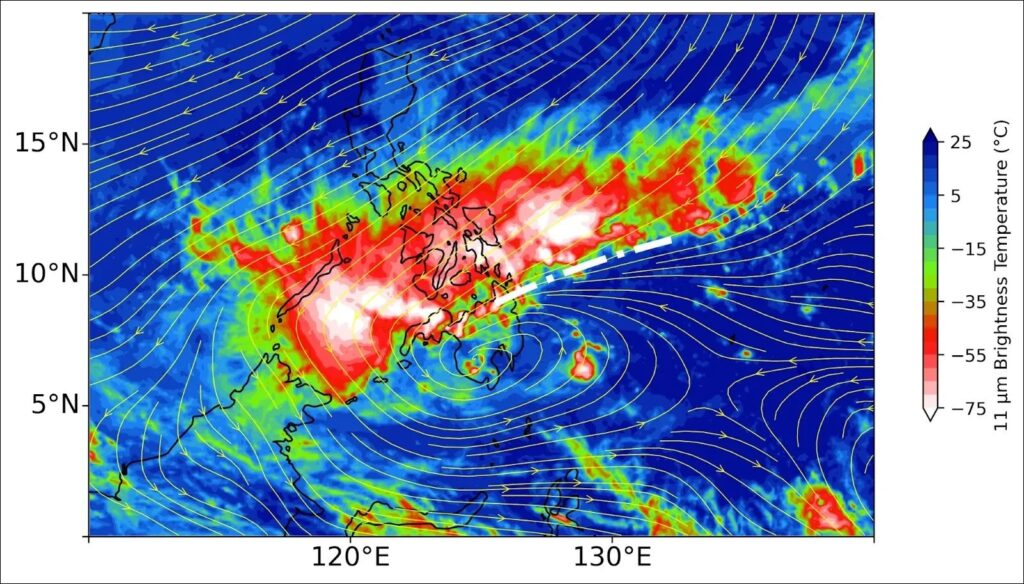
Shear lines are narrow bands. Warm and cold air masses converge here. They shift unpredictably. These form invisible barriers. These barriers frequently trigger downpours and floods. These systems are most active during the Amihan, or northeast monsoon season (November to March). The Philippines is already vulnerable to wet weather during this period. Unlike typhoons or cold fronts, shear lines lack a defined structure. They are especially featureless over warm ocean waters. This makes them extremely difficult to monitor via satellites. Traditional methods also struggle to track them.
The Challenge of Detection
Shear lines have been elusive and have eluded accurate tracking. “There are no universally accepted criteria for identifying them,” said lead researcher Lyndon Mark P. Olaguera, a physicist at Ateneo de Manila University. For example, cold fronts lose their structure over the ocean, morphing into shear lines that are harder to detect. This gap in monitoring has left communities exposed to sudden storms. Communities are particularly vulnerable during extreme events. An example is the 2017 rainfall disaster linked to shear lines.
A Physics-Based Breakthrough
A multidisciplinary team tackled this problem. They analyzed decades of weather data. The analysis focused on factors like wind patterns, temperature shifts, and moisture levels. They developed a physics-based algorithm that objectively detects and tracks shear lines. When integrated with artificial intelligence, the tool could enhance the monitoring of other weather systems. These include the Intertropical Convergence Zone (ITCZ). The ITCZ is a major rainfall source for the tropics.
The study was published in November 2025. It appeared in the Meteorological Society of Japan’s Scientific Online Letters on the Atmosphere (SOLA). This marks the first time researchers have created an objective index for shear lines. “This method fills a critical gap in weather monitoring,” Olaguera explained. By quantifying the role of shear lines in extreme rainfall, the tool helps identify high-risk areas. It also improves scientific understanding of how these systems evolve.
Applications and Benefits
The algorithm’s practical applications are vast. It can strengthen early warning systems. This is done by providing real-time data to agencies like PAGASA (Philippine Atmospheric, Geophysical, and Astronomical Services Administration). Forecasters could use it to predict rainfall hotspots, aiding disaster preparedness in vulnerable regions. Beyond forecasting, the tool supports climate studies by verifying numerical weather models. Scientists can now test whether simulations accurately capture shear lines and refine them if they don’t.
Collaborators included Tokyo Metropolitan University and PAGASA. “Our work could improve rainfall predictions during the monsoon season,” noted co-author John A. Manalo. For example, the 2017 rainfall event was analyzed to test the algorithm. It successfully identified the shear lines responsible, proving its effectiveness.
Future Steps
The algorithm is a major leap forward. The team aims to refine it. They plan to add more detection criteria. Experts like Jun Matsumoto (Tokyo Metropolitan University) and Faye Abigail T. Cruz (Ateneo) stress the importance of distinguishing shear lines from other converging air masses to enhance accuracy.
A Tool for Resilience
This breakthrough is a milestone in the Philippines’ weather monitoring capabilities. By combining physics-based methods with AI, the algorithm offers a model for tracking erratic weather systems. “The ultimate goal is to save lives and protect livelihoods,” said co-author Jose Ramon T. Villarin.
The research team—comprising Olaguera, Manalo, Matsumoto, Cruz, and Villarin—has set the stage for better weather resilience. Their work underscores the power of local scientific leadership and global collaboration in addressing climate challenges.
About the Study
Published in SOLA, the study is titled. It is called An Objective Method to Locate Shear Lines during the Northeast Monsoon Season in the Philippines. It is a testament to the importance of long-term weather data analysis. The climate continues to change. Tools like this will be vital for coping with extreme weather. They will help in building a safer, more informed society.


