
Ateneo de Manila University and the Manila Observatory led an international research team. This team made significant strides in enhancing sunny weather forecasts in the Philippines. Their work directly benefits industries such as solar power and agriculture. Their innovative approach has improved the accuracy of the Weather Research and Forecasting (WRF) Model. It particularly enhances predictions of sunlight levels. This led to a remarkable reduction in forecasting errors by up to 94%.
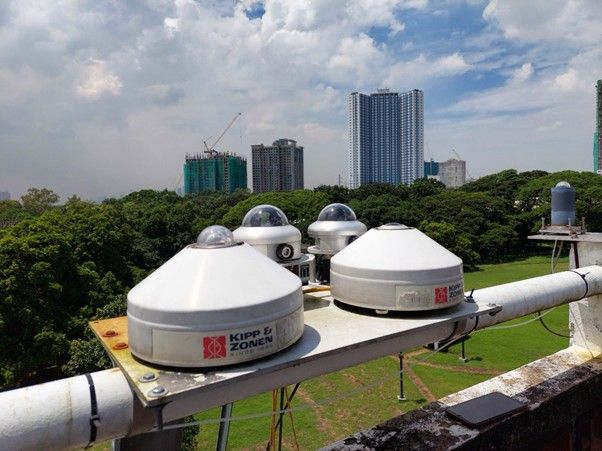
The researchers employed a mathematical algorithm known as the Kalman Filter (KF) To accomplish this. Analyzing data from various weather stations in Metro Manila. This method allowed them to minimize discrepancies. The difference between actual solar radiation observations and forecasts was reduced to as little as 6% under specific conditions.

Technically, incorporating the KF into WRF-Solar forecasts significantly decreased mean bias error (MBE). It also reduced root mean square error (RMSE). The optimal training period for the model varied seasonally. It required 42 days for the dry season and 14 days for the wet season. The KF proved effective in correcting forecasts during cloudy periods. However, it showed slight inaccuracies for clear skies. This was due to overcompensation.
This pioneering research suggests that the KF could serve as a cost-effective alternative. It may be better than more complex forecasting methods for solar energy applications. This finding highlights the potential for improved solar energy forecasting. Improved forecasting is crucial for renewable energy planning in the Philippines. The researchers emphasized the need for further optimization across diverse landscapes. They aim to ensure reliable solar energy predictions tailored to the region’s unique climate.
The findings of this study are published in the journal Solar Energy. It is the first of its kind to evaluate the performance of WRF-Solar and KF in the Philippines. The research team consists of experts from various institutions. They aim to apply their method to different topographies across the Philippines in future work. This will maximize the potential of irradiance data for effective solar energy forecasting.