
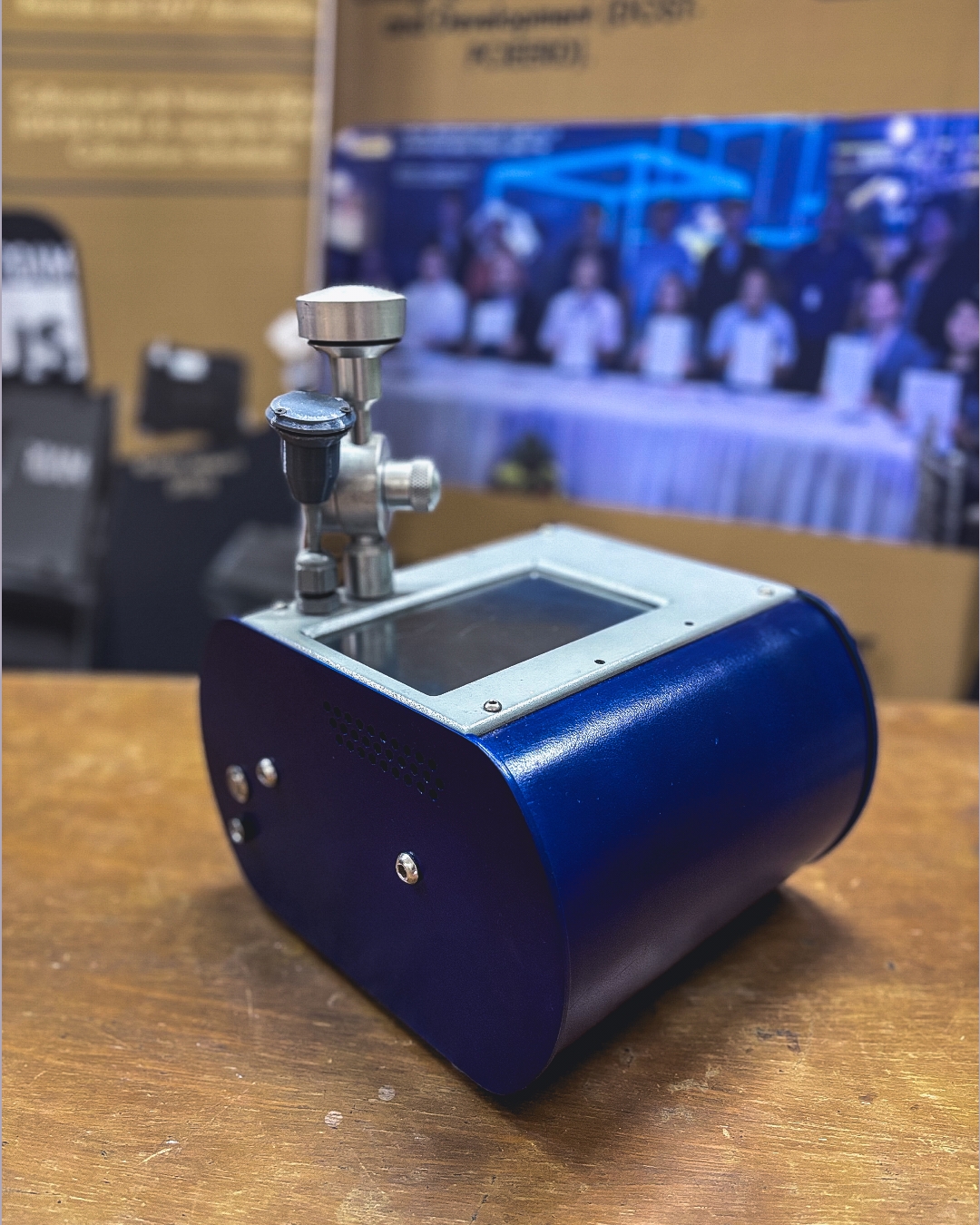
A Filipino chemist helped create the first local air quality monitor. The World Health Organization stresses that tracking air pollution is crucial for public health.
Dr. Len Herald Lim of the University of the Philippines Diliman College of Science (UPD-CS) worked on the project. He teamed up with Engr. Paul Alexander Darvin of UP Los Baños. Together, they developed the Robust Optical Aerosol Monitor, or ROAM, in 2014.
ROAM matches the performance of standard devices used in the industry and the Department of Environment and Natural Resources (DENR). The project began as a simple measurement idea. It progressed into a major technological innovation project using science and engineering.
UPD-CS held the Innovation Impact Stories webinar series. It explores how science and technology drive real-world changes. A program that highlights research driven innovations. A goal to inspire students, researchers, and educators to bridge academic theory with practical solutions.
It was in this webinar that the ROAM device was introduced. Dr. Lim tells the story of this invention as part of this webinar.
“In a sense, ROAM is an air microscope,” Dr. Lim said. “If you’ve experienced microscopy before, like cell counting under a microscope, this is very similar. The difference is that instead of cells, what we are counting are particles in the air.”
He noted that the device’s setup is not complicated. It does not require machining tiny parts.
Project ROAM saw its first long-term test in Cauayan, Isabela. The unit ran for more than half the year.
“The unit stayed there for about six to eight months,” Dr. Lim said. “There wasn’t anything particularly dramatic about it, except that it was placed in a dusty environment.”
Standard DENR monitors often struggle in dirty areas. Their devices were exposed to heavy pollution and needed frequent repairs and maintenance.
UPD-CS researchers assumed the ROAM unit would meet the same fate when it returned. After a thorough inspection, they were surprised the device was fully functional.
“It was impressive because I really expected it to be completely clogged,” Dr. Lim remarked. “The outside of the unit was so dirty, but it was still working. That’s because it doesn’t rely on a pinhole. It functions like a microscope.”
He added another detail about the design.
“And since it works like a microscope, its saturation limit is much higher than normal air monitoring equipment.”
The team tested the device in South Cotabato. The unit remained unattended there. It survived for six months. The cost to maintain the device is almost none. People doubt the equipment’s performance with almost no repairs done.
Local government units have shown interest in the Filipino technology.
“Right now, we’ve found that the best adopters of this technology are local government units (LGUs),” Dr. Lim concluded. “That was actually how we positioned and advanced Project ROAM. People started coming to us. We didn’t even know who referred them.”
Innovations from our local scientific and engineering community would continue to astonish us. Hopefully, the national government would support such initiatives for the improvement of Filipino’s quality of life.