

A new study confirms the Philippine eagle faces a grave survival threat. Researchers discovered the national bird has alarmingly low genetic diversity.
The Philippine eagle is one of the world’s largest and most powerful birds. It is currently listed as Critically Endangered. Habitat loss and fragmentation remain major dangers to the species.
Dr. Cynthia Saloma of the University of the Philippines-Diliman led a team of researchers. They studied the DNA of 35 eagles from the Philippine Eagle Foundation (PEF). The goal was to build a draft genome to guide conservation.
“A genome is a living organism’s complete set of genes,” the scientists explained. “From the extracted DNA sequences, we were able to assemble a representative genome for the species.”
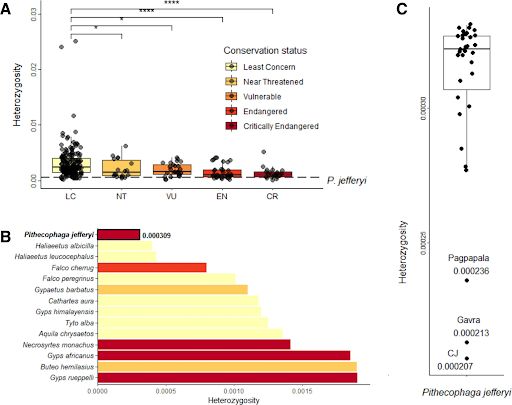
The team found that individual eagles are highly similar. They share nearly identical sets of genes. This lack of variation is dangerous for the bird’s future.
“The danger is that when there’s little variation, the species struggles to adapt to changes,” the researchers said. “For example, if a new disease appears or the environment shifts, most eagles would react the same way and have the same capacity to adapt—and if they’re vulnerable, the whole population could be wiped out.”
Low diversity increases the risk of inbreeding. Small, isolated populations often mate with close relatives. This can cause harmful genetic traits to emerge. Offspring may suffer from reduced fertility, weak immune systems, or physical abnormalities.
“In short, low genetic diversity makes the Philippine Eagle fragile and more likely to face extinction when challenges arise,” the team added.
The study suggests the decline began long before modern deforestation. Researchers believe the population may have struggled thousands of years ago. Rising sea levels likely fragmented once-continuous landmasses in Mindanao. This isolated eagle groups and disrupted their stability.
Human activities, such as early hunting and competition for prey, may have also pressured the population. The scientists noted these are still hypotheses. However, they help explain why the decline predates modern habitat destruction.
The research provides a roadmap for future conservation work. Experts say using DNA data will help manage biodiversity across the Philippines.
“By applying a genomics-driven, genetically informed approach, our study offers a blueprint for safeguarding other threatened species across the archipelago, and demonstrates how modern DNA analysis and bioinformatics can be leveraged to strengthen biodiversity management,” they said.
The findings were published in the journal BMC Genomics. The study is titled, “Genomic analysis reveals recent population decline and exceptionally low genome-wide heterozygosity of the critically endangered Philippine eagle, Pithecophaga jefferyi.”
Scientists from the Philippine Genome Center, UP Los Baños, and the Philippine Eagle Foundation contributed to the research. The team worked with 35 eagles living in protected facilities in Davao City.
The captive breeding program has continued for over 30 years. This new genetic data will assist scientists in their ongoing efforts to save the iconic bird from extinction.