
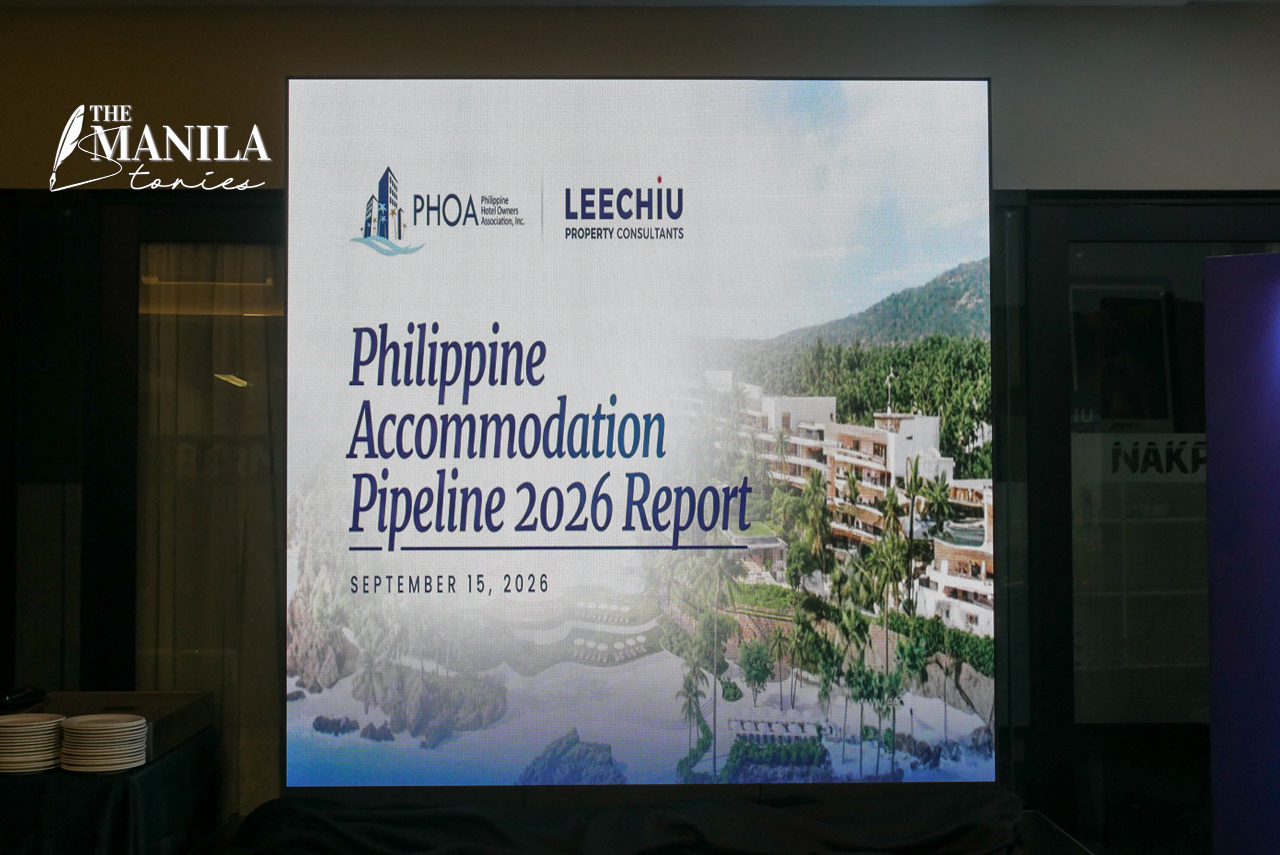
The accommodation industry in the Philippines shows solid growth. Private developers committed ₱387 billion in private capital. The pipeline now stands at 45,884 room keys across 213 tracked projects.
This [room] key supply will open between 2026 and 2032. The data comes from the 2026 Philippine Accommodation Pipeline Report. The Philippine Hotel Owners Association (PHOA) released the report with Leechiu Property Consultants (LPC).
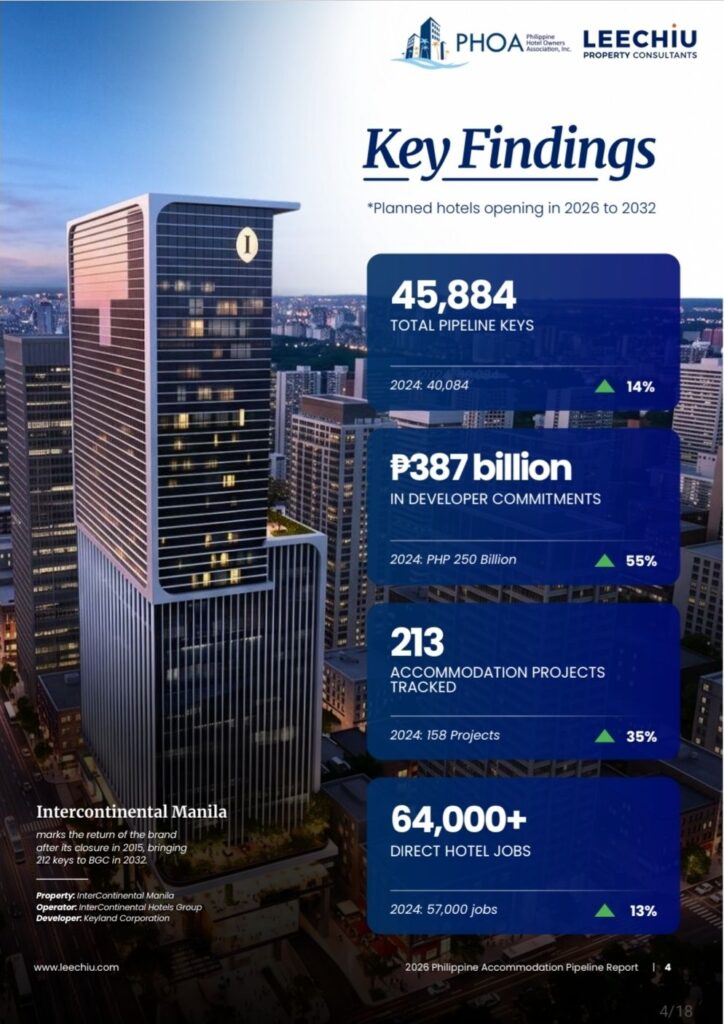
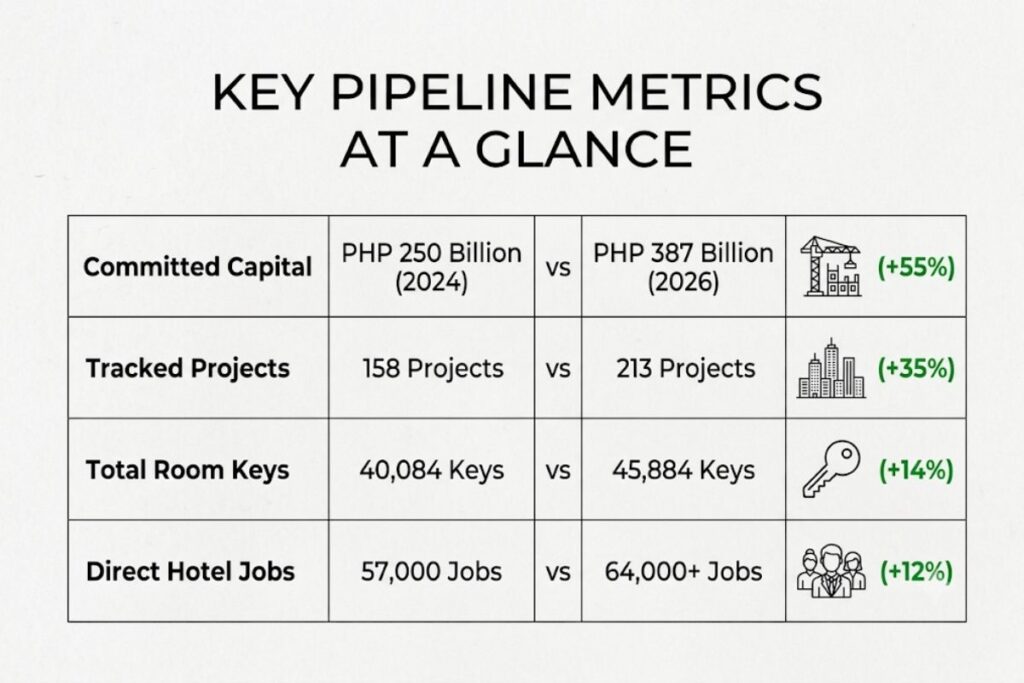
Capital commitments rose 55 percent. The previous report listed ₱250 billion in commitments. The total project count rose 35 percent from 158 to 213 properties. Key room counts increased 14 percent from 40,084 keys. The industry projects over 64,000 direct hotel jobs. The total job count grew from 57,000 direct jobs two years ago.
“Our members are committing capital on a scale the industry has not seen before, and they are doing it in regions that have historically been overlooked,” said Benito C. Bengzon, Jr., Executive Director of PHOA. “That is a vote of confidence in Philippine tourism. But whenever numbers like 45,000 new room keys are brought up, the immediate pushback from critics is always: ‘Do we really need more hotels?'”
“My response is simple: We are expanding our hotel accommodations to welcome a wider range of international and local travelers,” Bengzon said. “By building more rooms, we offer greater flexibility and diverse options to suit different travel preferences and budgets. Alongside this growth, we remain committed to enhancing the quality of our facilities and services to deliver an exceptional guest experience,” he added.
“Developers have committed ₱ 387 billion across 213 projects, and they have done it in the face of rising costs and a difficult financing environment,” said Alfred Lay, Director of Hotels, Tourism, and Leisure at Leechiu Property Consultants. “That is conviction. The question now is whether government ambition matches it, because we are competing for the same travelers as Vietnam, Thailand and Indonesia, and those markets are not standing still,” Lay said.
The market is building smaller properties across more destinations. Nationwide, 70 percent of pipeline keys are in destinations served by direct international flights.
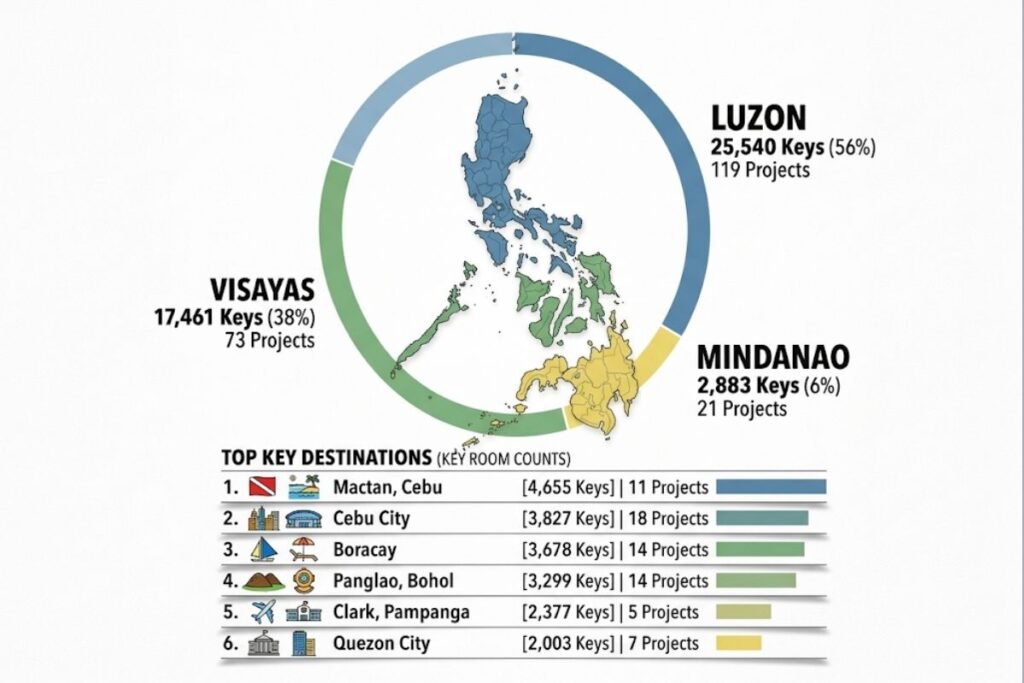
The Visayas leads national room growth. Central Visayas leads all regions in total key count. Development centers on Mactan, Cebu City, and Panglao. In the Visayas, 90 percent of keys sit in destinations served by international gateways.
Mactan leads national cities with 4,655 keys across 11 properties. Mactan-Cebu International Airport drives this expansion. Cebu City holds 3,827 keys across 18 properties. The opening of SM Seaside Arena strengthens venue capacity in Cebu City. Boracay holds 3,678 keys across 14 properties. Panglao holds 3,299 keys across 14 properties.
Development in the Visayas skews toward upscale segments. Upper upscale and upscale properties make up 48 percent of the Visayas pipeline. Branded residences and serviced apartments now expand across the region.
Mindanao projects increased 31 percent. The region now counts 21 tracked properties. Average property sizes fell in Mindanao. Developers build smaller formats for secondary cities.
Cagayan de Oro passed Davao as Mindanao’s largest market. Cagayan de Oro holds 1,293 keys across five properties. Davao holds 655 keys across three properties. Siargao holds six properties averaging 69 keys each. Upper midscale projects make up 52 percent of Mindanao supply.
Hotel expansion supports local tourism growth. Added rooms build capacity for foreign arrivals. High-end resorts attract luxury international travelers. International chains represent 47 percent of planned room supply.
These brands bring global recognition to emerging island destinations. Better accommodations encourage longer tourist stays. Increased capacity allows cities to host large international conventions.