
The Philippines and Japan signed a new space cooperation agreement on May 27, 2026. The deal strengthens ties between the Philippine Space Agency (PhilSA) and the Japan Aerospace Exploration Agency (JAXA).
PhilSA Ad Interim Director General Gay Jane P. Perez and JAXA President Hiroshi Yamakawa signed the declaration. The signing occurred during President Ferdinand R. Marcos Jr.’s state visit to Japan. The agreement focuses on satellite missions, space exploration, and sustainability.
President Marcos spoke about the partnership during a summit with Japanese Prime Minister Takaichi Sanae on May 28.
“As we mark the 10th anniversary of the launch into orbit of the Diwata-1 microsatellite from the Japanese module of the International Space Station this year, we are reminded of how our partnership has quite literally reached new heights, symbolizing our shared commitment to innovation, science, and the industries of the future,” Marcos said.
The two nations have a long history of cooperation. They hosted the 31st Asia-Pacific Regional Space Agency Forum in Cebu last November.
During that forum, the President emphasized the government’s focus on space science.
“Across the Asia-Pacific, nations are turning to space science as a means to improve governance, protect the environment, and to champion inclusive development,” Marcos said. “In the Philippines, PhilSA has been at the helm of our progress in space science and technology over the past six years. They regularly generate and distribute satellite data to national and local governments, researchers, and of course the private sector. These are used to aid disaster risk reduction and management as well as monitor the country’s maritime domain, among other functions. . . All these initiatives are guided by a simple conviction: Space must serve the people.”
The partnership is critical for disaster management. The Sentinel Asia project helps the Philippines request satellite data during emergencies. Filipino agencies made 20 such requests between 2024 and 2025. This data helps track floods, landslides, and volcanic activity.
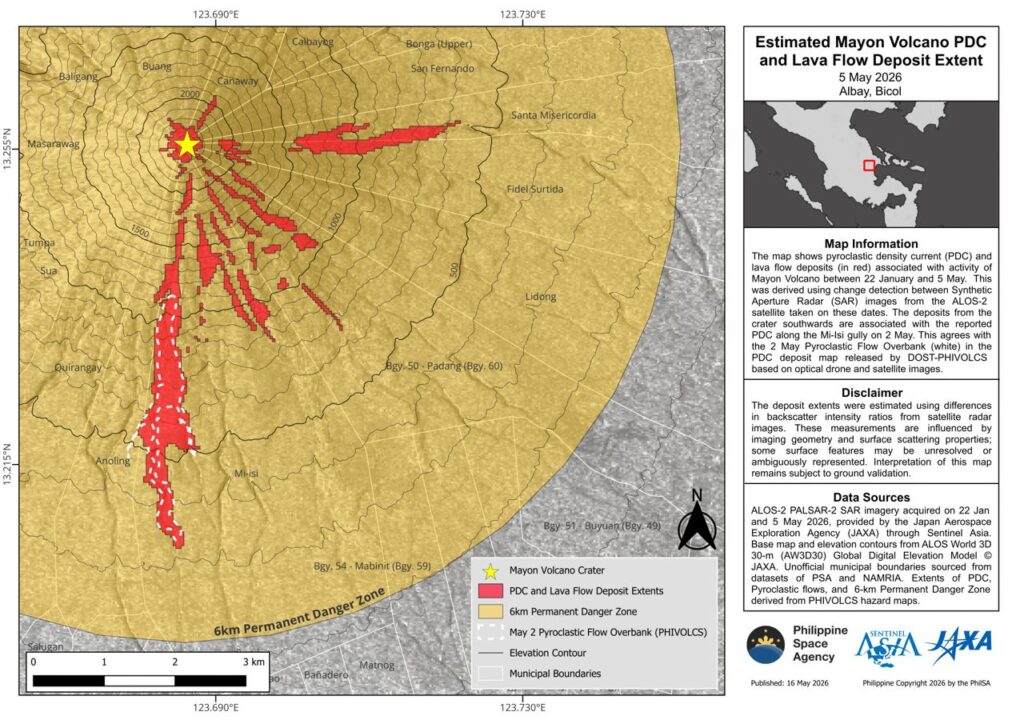
JAXA recently provided radar satellite images to map Mayon Volcano. This helped PhilSA track lava flows that were otherwise hidden by clouds.
The countries also collaborate on space education. Filipino students and researchers use the International Space Station for experiments. They participate in programs like the Kibo Robot Programming Challenge and the Asian Herb in Space project.
The two leaders plan to use this technology to improve food security and digital transformation. Both nations view this partnership as a path toward sustainable prosperity.