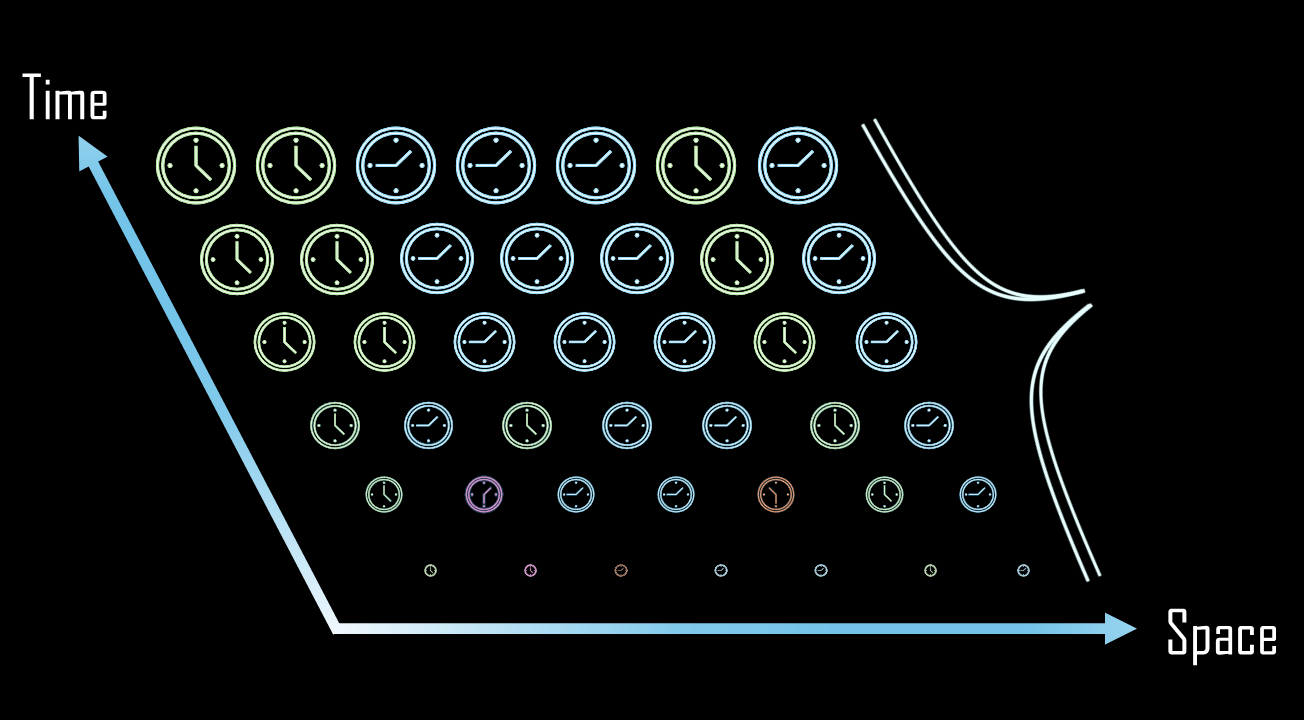
University of the Philippines physicists have discovered a universal rule in time crystal formation. The findings help scientists understand how these unusual phases of matter grow.
A time crystal is a phase of matter. Solids, liquids, and gases are traditional phases of matter. Unlike static solids, a time crystal exhibits a steady rhythm. It features a repeating pattern in its behavior over time.
The concept of time crystals is very new. Researchers still study how they form. They want to know if time crystal formation follows simple and universal rules.
Roy Jara Jr. and Dr. Jayson Cosme work at the UPD-CS National Institute of Physics. They proved that universality applies to time crystals. Universality means very different systems share the same underlying physics.
“We showed that the formation of a time crystal follows a universal rule similar to other simpler systems, such as a network of interconnected pendulums,” Dr. Cosme said. “This universal rule includes how fast time crystals form and the number of defects or imperfections that may arise.”
Time crystals emerge from particle interactions. Constituent particles interact with many others. Parts of the system also interact with the environment. This process is called dissipation. It is similar to air molecules escaping from a balloon.
The researchers demonstrated this universality using the Kibble-Zurek mechanism. This framework predicts defect formation during phase transitions.
“Defects in this case are ‘imperfections’ and the Kibble-Zurek mechanism predicts that the faster you force a system to change, by varying a parameter like temperature, the more defects you will create,” Dr. Cosme said.
A blacksmithing analogy explains this process. Blacksmiths rapidly cool red-hot steel in water. This rapid cooling traps internal stresses in the metal. Misaligned crystal structures form inside the steel. These defects make the metal brittle. Blacksmiths control the cooling process to reduce defects and strengthen the metal.
The UP physicists studied two different models. One model was classical and used interconnected pendulums. The other model was quantum and used quantum spins interacting with light.
Both models exhibited the exact same behavior during time crystal formation. The formation delay and the defect count followed identical laws. Both outcomes depended on the speed at which the system was driven.
These results have major implications for future quantum technologies. Researchers want to use time crystals for quantum information and sensing. These applications require reliable preparation methods.
“We predict that time crystals can not be prepared arbitrarily fast due to an inherent delay in their formation, especially close to the transition point at which they emerge,” Dr. Cosme said.
“Also, if one aims to scale this up into a network of time crystals, extreme care must be taken regarding the speed of creation. Because these systems are subject to the Kibble-Zurek mechanism, we have shown that pushing the transition too quickly will inevitably lead to the formation of unwanted defects, which could compromise the stability and utility of the entire network.”
The research team published their study in Physical Review B. The journal is a trusted source for condensed matter physics. The study is titled “Universality of dissipative discrete time crystal formation.”