Opening a monthly electricity bill in the Philippines isn’t just a routine chore; for millions, it is a recurring moment of financial dread. This isn’t just a household grievance; it’s a national crisis. According to the Department of Energy (DOE), the Philippines now holds the dubious honor of having the highest average residential electricity rate in Southeast Asia.
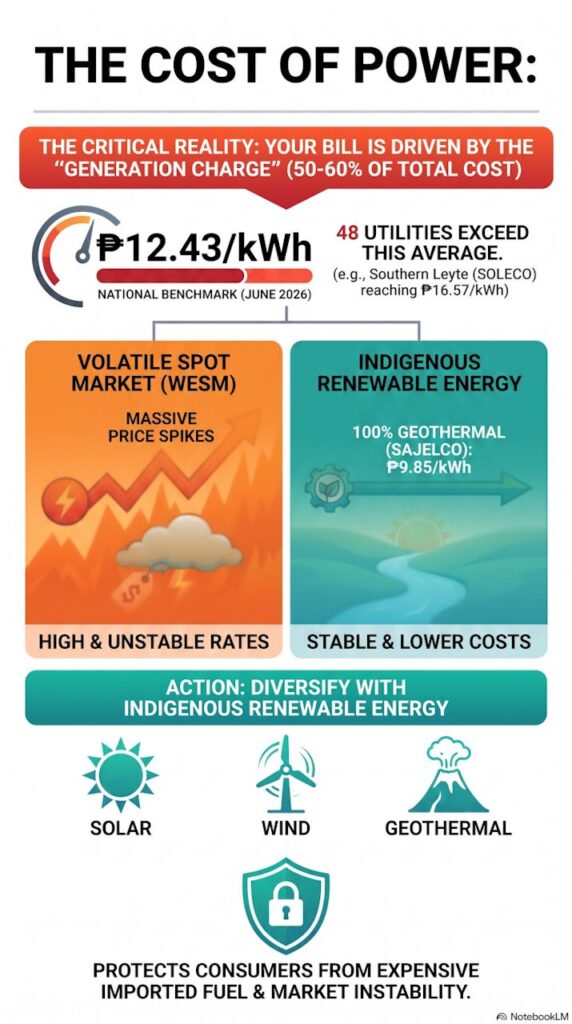
But here is the hidden truth that policymakers often gloss over: the “national average” is a mask. While ₱12.43 per kilowatt-hour (kWh) is the cited benchmark, it serves to hide a systemic failure that drains the pockets of every Filipino household living outside the statistical mean. For a staggering number of families, this average is a low-ball estimate that bears no resemblance to the punishing reality of their monthly expenses.
The “National Average” is a Mirage for Millions
Data from June 2026 exposes a massive disparity in what we pay for the basic right to light our homes. While the government discusses a national average of ₱12.43/kWh, an analysis by the Institute for Climate and Sustainable Cities (ICSC) reveals that 48 on-grid distribution utilities (DUs)—nearly a third of the country’s providers—charged rates significantly higher than that figure.
The disparity is most aggressive in provincial areas served by cooperatives. A disparity with the top three highest-charging utilities reaching predatory levels:
- SOLECO: ₱16.57/kWh
- AURELCO: ₱16.42/kWh
- LEYECO 4: ₱16.00/kWh
Even the nation’s primary economic hub is not immune. MERALCO, the country’s largest utility serving Metro Manila, recorded a rate of ₱14.48/kWh in June 2026—well above the ₱12.43 benchmark. When the largest utility in the country fails to meet the “average,” it proves that the national benchmark is a poor metric for local policy and household budgeting.
The “Generation Charge” is the Real Budget-Killer
To fix the bill, we must look at what actually drives it. The “Generation Charge” is the true budget-killer, typically devouring 50% to 60% of your total payment.
Consider a standard ₱1,000 electricity bill. Roughly ₱500 to ₱600 of that hard-earned money goes directly to the cost of generating power. The rest are secondary: transmission, distribution, and taxes. Alberto Dalusung III, Energy Transition Advisor for ICSC, makes the stakes clear:
“While recent public discussions have focused on the various charges reflected in electricity bills, the generation charge consistently accounts for the largest share of what consumers pay. This highlights the need for a more diversified power mix centered on indigenous renewable energy resources and improved power procurement strategies that prioritize affordability, energy security, and resilience.”
Procurement Strategy: The Secret Ingredient to Affordability
Why does one household pay ₱16/kWh while another pays under ₱10? The answer isn’t geography; it’s the utility’s procurement strategy.
Electricity rates are dictated by a utility’s exposure to the Wholesale Electricity Spot Market (WESM). Think of WESM as the “emergency convenience store” of electricity: it’s where utilities go when their regular supply fails, and like any convenience store, the prices are always marked up. When coal plants go offline—as they frequently do—utilities are forced into this volatile spot market, and those costs are passed directly to you.
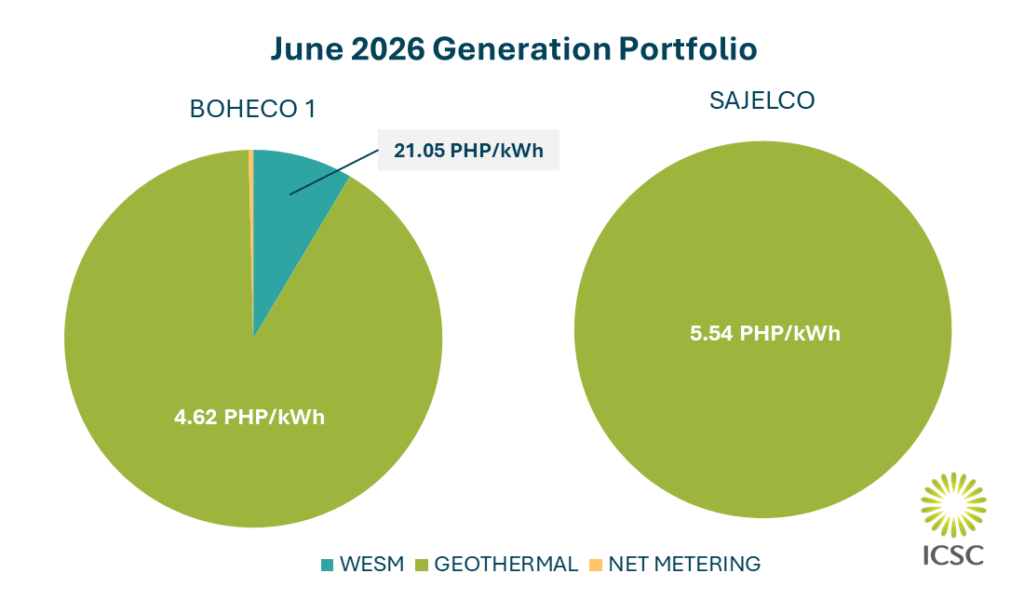
The “smoking gun” can be found in the June 2026 data for BOHECO 1 in Bohol. Their procurement strategy provides a startling contrast:
Their geothermal power cost only ₱4.62/kWh.
Their WESM (market) purchases cost a staggering ₱21.05/kWh.
In a single month, market power was nearly five times more expensive than their local renewable source. This is why success stories like SAJELCO in Nueva Ecija (charging only ₱9.85/kWh) and BOHECO 1 (₱10.80/kWh) exist. By relying on indigenous geothermal energy, they created a “shield” against global coal price hikes and the “convenience store” prices of the spot market.
Breaking the Information Monopoly: PRESYO-PH
For decades, the true drivers of your electricity bill were buried in complex corporate disclosures, hidden from public view. The PRESYO-PH (Power Rates and Energy Supply Overview for the Philippines) platform is a first-of-its-kind weapon designed to break this information monopoly.
By making data from over 140 DUs publicly accessible, PRESYO-PH empowers consumers and researchers with:
Historical Trends: To identify which utilities are prone to constant price volatility.
Supply Mix Insights: To see exactly how much coal or gas is inflating your bill versus cheaper renewables.
Verified Sources: Traceable data that demands accountability from utility boards.
This transparency is the first step toward energy security. We can no longer afford to let utilities hide their poor procurement choices behind a veil of technical jargon.
The Path Forward: From Imports to Indigenous Power
The verdict is in: the path to lower bills does not lie in imported fossil fuels that leave us at the mercy of global markets. The solution is the aggressive diversification of the Philippine power mix with indigenous renewable energy.
Reducing our dependence on imported coal is not just an environmental aspiration; it is a practical economic necessity for the Filipino family. When we prioritize local, stable resources like geothermal, solar, and wind, we protect our homes from the budget-killing spikes inherent in the current system.
It is time to stop accepting the “national average” as an excuse for inaction. I challenge you: use the PRESYO-PH tool today. Look up your local utility and compare your rate against SAJELCO’s ₱9.85 benchmark. If you are paying more, it’s time to ask your utility leaders a hard question: Why aren’t you sourcing power that works for our wallets?